By Alex Jimenez, Managing Director, Consulting, Finalytics.ai
The industry has been calling segmentation personalization for twenty years. The gap is starting to show.
What Most Institutions Are Actually Doing
Most community banks and credit unions doing anything at all around personalization are doing it in the campaign layer – segmented email lists, targeted SMS, audience-specific messaging calibrated to where someone is in their relationship with the institution or where they are in a product decision. This reflects real data discipline and genuine marketing sophistication. It is also, for most institutions, where the effort stops.
A 2023 Mastercard Dynamic Yield study found that 86% of financial institutions say personalization is a visible priority. The same study found that fewer than half of executives and fewer than a third of middle managers reported having a dedicated personalization owner or team. Stated priority and operational reality are running on separate tracks at most institutions.
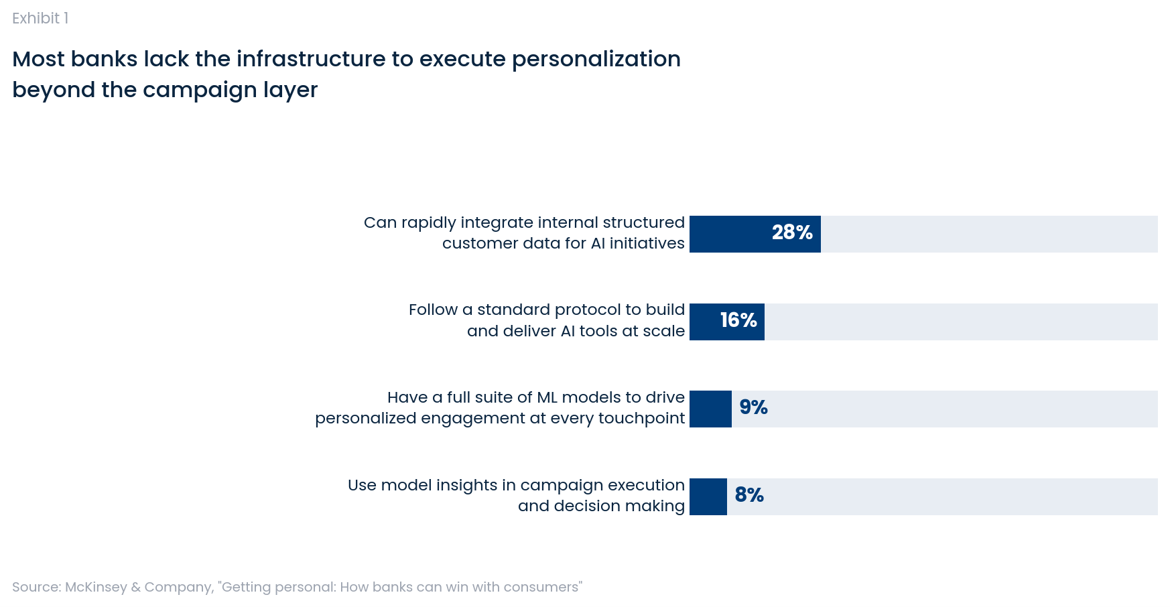
McKinsey's research makes the same point in sharper numbers. Only 8% of banks use model insights in campaign execution and decision making. Only 9% have a full suite of machine learning models capable of driving personalized engagement at every customer touchpoint. Just 16% follow a standard protocol to build and deliver AI tools at scale. And only 28% can rapidly integrate internal structured customer data for AI initiatives. The way most institutions are organized produces campaign-level outputs because the operating model was designed for campaigns, not for continuous engagement with individuals.
The Gap No One Is Talking About
A campaign targets a segment. The website does not know any of it happened.
A visitor who clicked a targeted auto loan email and a visitor who found the site through a generic search engine query arrive at the same page and see the same experience. The headline is the same. The featured products are the same. The calls to action are the same. Everything the campaign team did to get the right message to the right person ends the moment that person clicks through to the site.
For a CXO, this is a strategy gap. The investment in audience intelligence has no connection to the primary digital experience the institution controls.
For the digital or marketing leader, this is an execution gap. The work done to reach the right person with the right message stops one click short of where that person makes a decision.
The Signal You Are Already Collecting
Most institutions use UTM tags to track campaign traffic. Source, medium, campaign name appended to the URL. That data arrives with every visitor who clicks through from an email, an SMS message, or a paid placement. It identifies exactly where they came from and what brought them to the site.
In most cases, the website logs it and moves on. It appears in an analytics report that someone reviews days later. No one acts on it at the moment it matters, which is when the visitor is on the site and still deciding.
This is not a data problem. The data exists and is already being collected. The website has no capability to receive that signal and respond to it in real time.
Why Landing Pages Are Not the Answer
Some institutions recognize this gap and respond by building campaign-specific landing pages. A dedicated page for the auto loan email. A separate page for the CD promotion. A custom entry point for each major audience segment.
This is better than sending every visitor to the homepage and hoping for the best. A static page built for a segment does not respond to what a visitor does once they arrive. It does not remember them if they return. It does not connect to anything else the institution knows about them. It delivers one fixed experience to everyone who shares a single campaign attribute, and it stops there.
There is also an operational cost that teams rarely account for upfront. Landing pages accumulate. Campaigns end. Pages do not. No one owns the cleanup. Teams that have run campaign landing pages for any length of time recognize the problem: a shadow inventory of orphaned pages, inconsistent brand execution, and content that surfaces in search long after the promotion it supported has expired. The static landing page approach does not just underdeliver on what personalization requires. It creates a management burden that compounds with every new campaign.
What the Data Shows
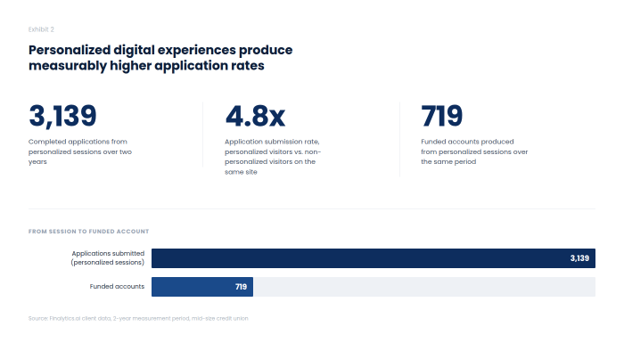
A mid-size credit union has been running an AI personalization platform across its public website for two years. Over that period, the platform generated 3,139 completed applications from personalized sessions. Visitors who received a personalized experience submitted applications at 4.8 times the rate of visitors on the same site who did not. Those applications produced 719 funded accounts.
That outcome did not come from better campaign landing pages. It came from a website that could finally act on the signal arriving with every visitor instead of ignoring it. The campaign work did not become less important. It became more effective, because for the first time it was connected to a destination that could receive it.
Where Yours Stops
The executives I met at that conference had built something real. Segmented campaigns require data discipline, organizational alignment, and sustained execution. That work has value.
The question worth sitting with is what it is connected to. If a visitor responds to a targeted message and arrives at a website that treats them identically to every other visitor, the effort invested in reaching that person stopped short of where that person decides.
Closing that gap does not require rebuilding the campaign program. The audience intelligence already exists. The signals are already being collected. What is missing is a website capable of acting on what the institution already knows, at the moment a visitor is present and making a decision.
The question is not whether personalization works. A 4.8 times application submission rate on a live site over two years answers that. The question is where yours stops, and whether that is a strategic choice or an infrastructure limitation that has not yet been addressed.
Where Do You Stand?
Consider where your institution's effort around personalization currently ends. If the honest answer is somewhere between the send button and the homepage that gap is worth examining.
Finalytics.ai works with community banks and credit unions at exactly this inflection point. If you want to think through what connecting your campaign layer to your website experience looks like in practice, we are glad to have that conversation.
Connect with Finalytics.ai to learn more.