By Alex Jimenez, Managing Director, Consulting, Finalytics.ai
Budget season is closer than it feels. Behavioral intelligence is easier to approve than you think.
Every year, community banks and credit unions go through the same planning ritual. Budgets get assembled, priorities get ranked, and decisions get made about what the institution will invest in for the coming year. Most of the investments that make it into those budgets have a clear category, a line item they fit into, a department that owns them, and a track record the CFO can point to. The ones that don't tend to get deferred, not because they lack merit, but because the internal path to approval is unclear.
Behavioral intelligence, the capability that reads what a visitor does across digital channels in real time and responds to it, tends to fall into that second group. Not because it is expensive or unproven. Because most institutions have never had to buy something quite like it before, and the internal conversation about it does not follow a familiar script.
This issue is about that conversation. Specifically, what tends to get in the way, and what tends to work, based on what we have seen across the institutions we work with.
What Gets In the Way
The first obstacle is structural. The person who feels this problem most directly, whoever owns the website day to day, is rarely the person who approves the budget. That person has to carry the case upward, through at least one layer and sometimes more, to whoever controls the spending. At some institutions, that is the CMO. At others, it is a CIO, a CXO, or the executive team directly. The chain varies. What does not vary is that the case has to survive the retelling, and most people carrying it upward do not yet have the specific, verified numbers that make it stick.
The second obstacle is categorical. Behavioral intelligence sits at the intersection of marketing, technology, and digital strategy. That means it can fall between budgets as easily as it can fit inside one. Marketing sees it as a technology purchase. Technology sees it as a marketing tool. Digital strategy, where it exists as a distinct function, may already have a full plate. The result is a capability that everyone agrees is relevant and nobody is sure who should own it, even though the investment itself is modest enough that it does not require board approval or a major budget reallocation.
The third obstacle is the ROI question, which comes up in every internal conversation about a new digital tool without exception. Without a real number to anchor it, that question tends to stop the conversation rather than move it forward. A general claim about personalization lifting conversion rates is easy to dismiss. A specific, verified figure from a real institution is not.
What Tends to Work
The institutions that successfully get behavioral intelligence into their budget tend to do a few things differently.
Timing matters. Starting the conversation during planning season rather than after it closes is the path of least resistance toward a 2027 start. For most community banks and credit unions, budgets take shape in late summer and early fall, and getting something into that conversation is easier than adding it later. That said, most institutions are not so rigid that nothing gets approved outside the planning window. Unbudgeted expenses get approved regularly when the case is strong enough, and a well-constructed case made in October can still become a January approval.
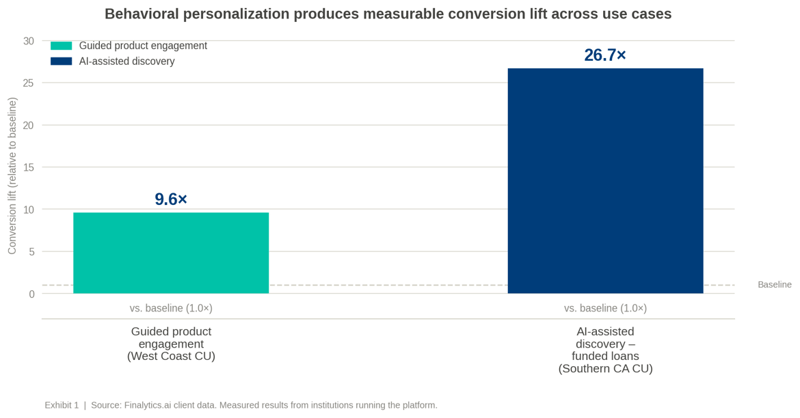
The case itself needs to be specific. Whoever carries this conversation upward needs real numbers from real institutions, not a general argument about the value of personalization. Across the institutions we work with, personalized sessions convert at four to five times the rate of non-personalized sessions. At one West Coast credit union, guided product engagement, calculators, and decision support tools responding to real visitor behavior produced a 9.6 times lift in conversion. At a southern California credit union, AI-assisted discovery produced a 26.7 times lift in funded loans. These are not modeled outcomes. They are measured results from institutions already running the platform. The person carrying this case upward does not need to make a theoretical argument. They need to hand someone a number and a source.
How this gets framed also matters. A technology purchase gets evaluated on features, implementation timelines, and integration complexity. When behavioral intelligence is presented that way, it competes against every other item in the technology budget and loses context. When it gets framed as a competitive positioning decision, the conversation shifts to what happens to the institution's market position if it moves, and what happens if it does not. The institutions already running behavioral intelligence are not ahead because they bought better technology. They are ahead because they started building a record of their own members' behavior earlier, and that record compounds the longer it runs.
The ROI Question
The ROI question deserves its own answer, stated plainly. Across our client base, behavioral intelligence pays for itself in around two quarters, and sometimes less. That is not a projection. It is what we have observed across the institutions that have implemented it.
What makes that credible is not the number itself but the logic behind it. A system that reads what a visitor is trying to do and responds to it in the same session does not need a long runway to produce results. The lift shows up in the first funded loans, the first completed applications, the first members who arrived researching a product and left having started one. The payback period is short because the mechanism is direct: recognized intent, relevant response, funded outcome.
What the Research Shows
Institutions that rely on member demographics to decide what to show a visitor are working with the wrong data.
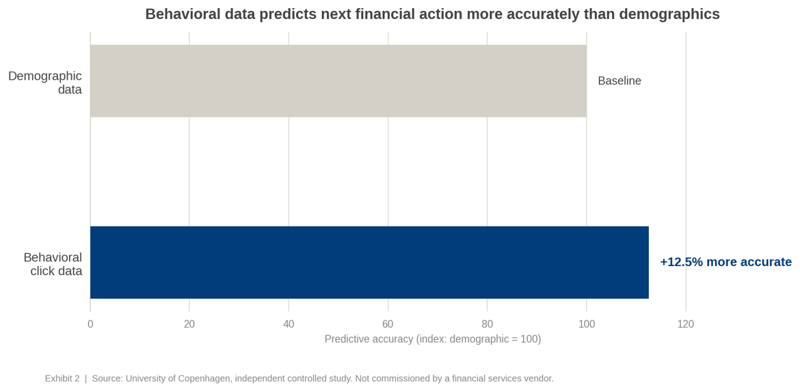
Researchers at the University of Copenhagen ran a controlled test to see which better predicted what a website visitor would do next financially: what they did on the site, or who they were. The behavioral data won, and it was not close.
Watching what someone did, in what order, predicted their next move 12.5% more accurately than knowing their demographic profile. The study was conducted independently of any financial services vendor. It was not a pilot program, a case study, or a projection. It was a controlled academic test, and the result was unambiguous: what someone does tells you more about what they will do next than who they are on paper.
The longer a system reads that behavioral data, the more accurate it gets. Demographic data, the kind every institution already has, cannot close that gap.
The Gap Does Not Wait
Every month an institution spends deciding is a month its website keeps running without this capability, while institutions already running it keep building a record their systems use to improve. A competitor that started a year ago is not just a year ahead in calendar time. It is a year ahead on a curve that gets harder to close the longer it runs.
The internal conversation about behavioral intelligence is not easy. The path to approval is not always clear, and the right person to champion it varies by institution. But the institutions that have that conversation this planning season are the ones that will be a year further along that curve by the time next planning season arrives. The ones that defer it will be starting the same conversation twelve months from now, from a position that is harder to close from than the one they are in today.
The first step is not a business case. It is a conversation, with us, and if it helps, with the institutions already running this that can speak to what it looks like in practice.
Connect with Finalytics.ai to learn more.