By Alex Jimenez, Managing Director, Consulting, Finalytics.ai
The outcome shapes the vendor selection, the implementation, the internal alignment, and the ability to measure progress. That definition must exist before any other conversation begins.
Six years ago, we were brought in to help a credit union define their digital strategy. Their strategic plan was genuinely well constructed. Each initiative had a clear problem statement, defined outcomes, ROI rationale, and success metrics. The leadership team had done serious work.
Then, at the bottom of the list, one line: AI. No problem statement. No outcome. No metrics. Just a budget number.
When we asked about it. We were told the board had pushed for it. They expected to see AI on the plan. So, it went on the plan.
The following year, the team used the budget for RPA. A real operational need, a pragmatic call, and a defensible use of the funds. But the original intent, whatever AI was supposed to accomplish, had never been defined. Nobody could point to an outcome that was or was not achieved. Without a documented outcome on record, anyone in leadership could have come back and argued the funds were misallocated, even if the RPA decision was exactly right.
The technology was on the plan. The outcome never was.
This Is Not an Isolated Story
Financial institutions approve technology budgets without attached outcomes more often than most would admit. The pressure comes from multiple directions. Boards that want to see innovation on the roadmap. Vendors with compelling demos.
Peers at conferences describing pilots as transformative. The technology goes on the plan. The outcome gets filled in later, or not at all.
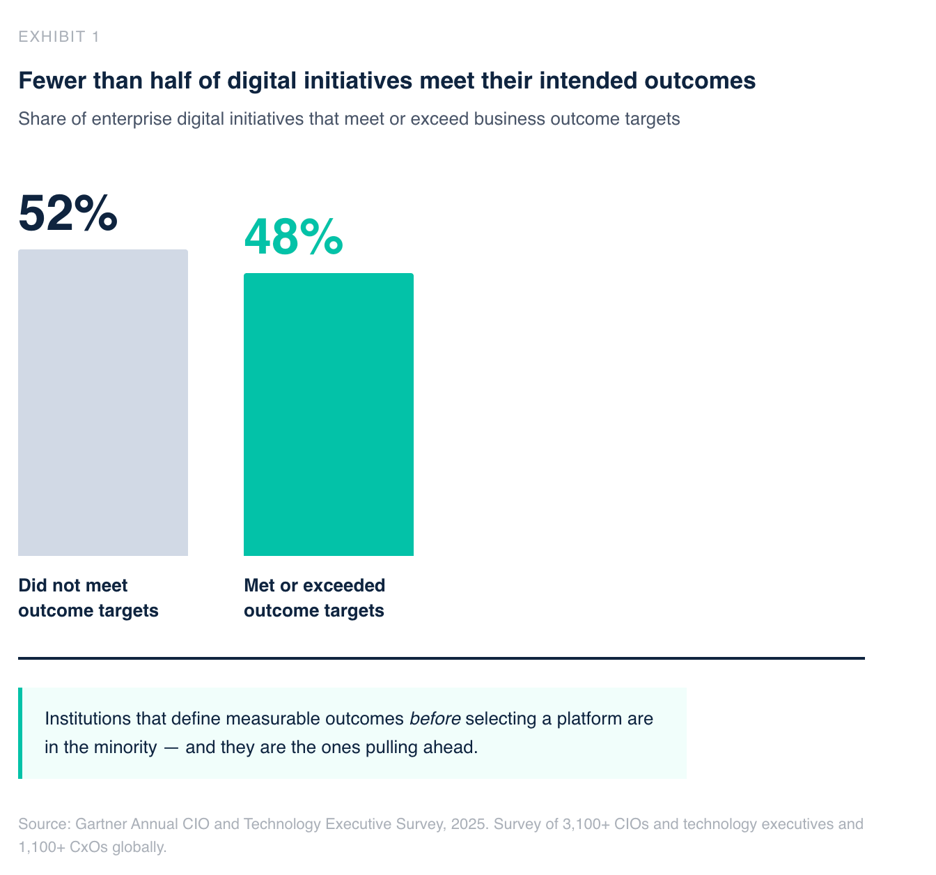
Gartner surveyed more than 3,100 CIOs and technology executives and found that fewer than half of digital initiatives meet or exceed their intended business outcome targets. The institutions in that majority did not fail because the technology was wrong. They failed because the outcome was never defined clearly enough to build toward.
When the outcome is undefined, the investment finds whatever use is nearest. That may produce something useful. It rarely produces what the original purchase was meant to deliver. And it leaves the institution without a way to demonstrate that the investment worked.
I watched this pattern repeat itself across institutions with CRM. The pitch was broad and compelling: one platform that would make marketing, sales, branches, and the call center more efficient. A single source of truth about the customer. The capability was real. But the outcomes were never defined precisely enough to drive implementation toward them.
Sales teams balked at adoption because nobody had defined what they were supposed to do differently. Marketing and the call center needed additional configuration that could not be justified after the base platform was purchased. Branches had no clear use case to begin with.
The platform sat underutilized, adding cost and complexity while the transformation it promised remained out of reach. The platform was not the problem. The sequence was. Technology was bought before outcomes were defined, and the implementation had nowhere specific to go.
Behavioral Intelligence Is Arriving the Same Way
The language around behavioral intelligence today carries the same shape as those earlier CRM pitches. A system that will transform how you know and serve your members. Broad capability. Many potential use cases. A long horizon before the full value is realized.
That does not mean behavioral intelligence is oversold. It means the purchasing dynamic is familiar, and the failure mode is predictable. Institutions that put it on the roadmap because the board expects to see AI will get the same result they got with every other technology bought in that order. A budget line that finds a use. A transformation that never arrives.
What Behavioral Intelligence Actually Is
Bought for the right reasons, behavioral intelligence is not a campaign tool or a content feature. It is an intelligence layer, and the distinction matters.
It captures member behavior across the digital experience: the public website, digital banking sessions, product inquiries, abandoned applications, and transaction patterns where available from the core.
It interprets that behavior as intent, turning raw signals into a read on where a member is in their financial life and what they are likely to need next.
It activates that intelligence across the digital experience, so the website and digital banking adapt to the individual member rather than broadcasting the same experience to everyone who visits.
When the layer is in place, the digital experience becomes more relevant over time. A feature changes what someone sees. The intelligence layer changes what the system knows and can do, and it compounds in value the longer it operates.
The Outcome Has to Come First
Institutions that define what they want behavioral intelligence to produce before selecting a platform can do three things that institutions buying on momentum cannot.
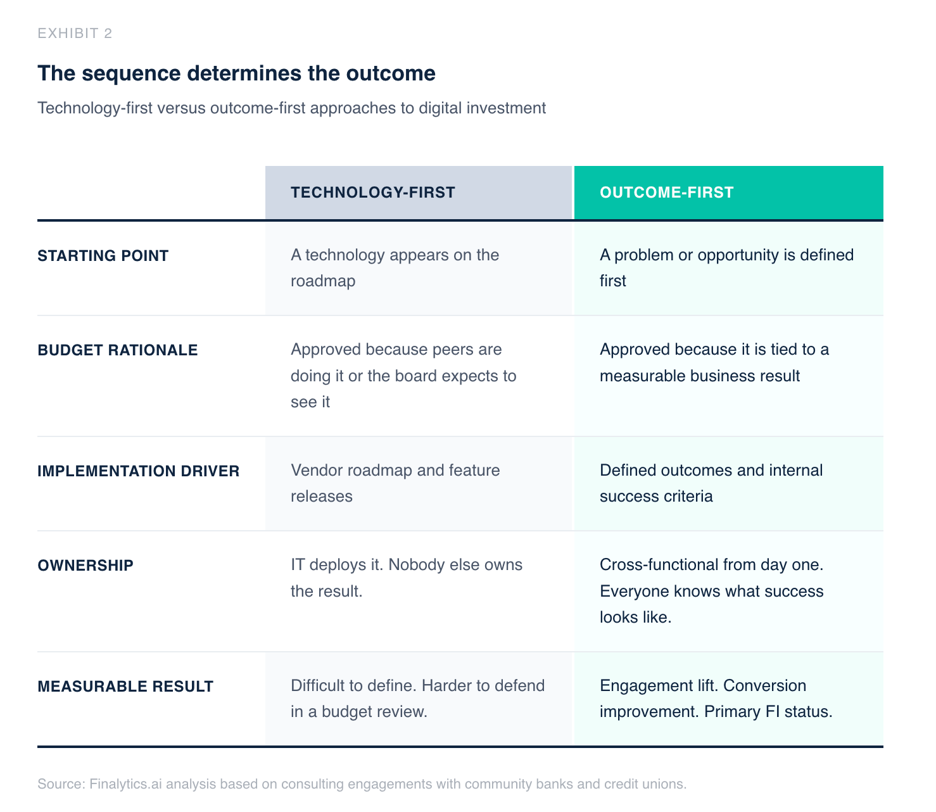
They can evaluate options against something concrete. Not which vendor runs the most impressive demo, but which platform produces the outcomes they defined before walking into the room.
They can build internal alignment before implementation begins. When the outcome is specific, the conversation about ownership, measurement, and success criteria can happen before the contract is signed rather than after the first difficult quarter.
They can measure progress. Engagement lift. Conversion on high-value products. Primary financial institution status among members who were at risk of leaving. These are outcomes. They are measurable and defensible in a budget review. Adding behavioral intelligence to the roadmap because it sounds like the right direction is not.
The Choice in the Next 90 Days
Budget planning for most financial institutions begins in late summer. The institutions building their 2027 plans right now are making a choice that will determine more than a line item. They are deciding whether behavioral intelligence becomes a foundation or a placeholder.
The board may already be asking about AI. The vendor conversations may already be scheduled. The pressure to put something on the roadmap is real.
But the institutions that will look back on 2027 as the year things changed are the ones that defined the outcome before they defined the budget. Not the ones that approved the line item first and figured out the rationale later.
The next several issues will cover what the behavioral intelligence layer does, what the member experience looks like when it works, and what it costs an institution to start later rather than now. The technology is ready. The question is whether the outcome is defined clearly enough to build toward it.
That part does not come from a vendor. It comes from the institution.
Connect with Finalytics.ai to learn more.