By Alex Jimenez, Managing Director, Strategy, Finaltyics.ai
Predictive analytics requires more than the right tools and clean data. Getting an organization to trust it can take years. The institutions that get there are pulling ahead of the ones that haven't started.
Every Monday morning, somewhere in a community bank or credit union, an executive team pulls up last quarter's numbers. They debate what the trends mean. They make decisions based on experience, instinct, and “good old gut-feeling” built over decades. Nobody questions the process. This is how banking has always worked.
Instead of looking ahead, bankers look at the future through the rear-view mirror. And changing vantage point turns out to be harder than anyone wants to admit.
When Instinct Outranks Evidence
Banking rewards experience. Tenure gets promoted. Instinct gets deferred to. A leader who has managed through three recessions carries more authority in a planning meeting than a model that has processed three billion transactions. That dynamic is understandable. It is also why most analytics initiatives in community banking quietly die.
Community banks and credit unions are sitting on years of transaction history, behavioral signals, and product usage patterns. When that data produces a conclusion that contradicts what a senior leader believes, the model gets questioned. The methodology gets scrutinized. And eventually the dashboard gets ignored.
This is a culture problem dressed up as a technology problem. Organizations keep calling it a technology problem because that version is easier to solve.
What I Learned Trying to Change It
When I was named head of deposit operations after an unexpected leadership departure, I walked into a team being managed almost entirely on instinct. The data existed. Transaction records, processing volumes, staffing logs. None of it was organized in a way that made it usable. My managers had no daily metrics on what their teams were processing. Decisions were made by feel.
I spent three and a half years trying to build data discipline into that organization. I built dashboards, staffing models, and reporting frameworks. I also owned the deposit and payments P&L, which meant producing an annual budget. My predecessors had done it by taking the prior year's numbers and adding five to ten percent, based on nothing more than optimism. I built a model instead, one that accounted for actual drivers, and it got close for three consecutive years.
What I could not do was convince the executive team that a predictive model would change how they managed the business. The data was available. The logic was sound. The model was demonstrably more accurate than the method it was replacing. None of that was enough. The leaders in that room had spent decades being rewarded for their judgment. A model that outperformed that judgment was not a useful tool. It was a challenge to their authority.
I left before I could close that gap. I am not sure more time would have mattered.
A report that tells you 200 members left last quarter gives you something to discuss. A model that tells you 200 members are showing early signs of attrition this quarter gives you something to do.
Predictive Analytics Changes What You Can See
The technology itself is less complicated than the culture around it. Predictive analytics does not require new data. It uses the same history that already lives in your core systems, pointed in a different direction. Historical reporting tells you where you have been. Predictive modeling tells you where you are likely going.
That shift matters because it changes when you can act. A report that tells you 200 members left last quarter gives you something to discuss. A model that tells you 200 members are showing early signs of attrition this quarter gives you something to do.
The window for action is open. Whether anyone walks through it depends entirely on whether the organization trusts the signal enough to move.
Models are wrong sometimes. Every experienced banker has a story about a score that missed or a recommendation that damaged a relationship. That experience is valid. The question is whether gut instinct, applied across thousands of members simultaneously, outperforms a well-constructed model over time. The evidence says it does not. But evidence has never been the obstacle.
The Channels Already Exist
When analytics does get used, the infrastructure to act on it is already in place. Digital banking. Email. The call center. The relationship banker who picks up the phone. An insight does not need new systems to be useful. It needs to be routed to one of those channels at the right moment.
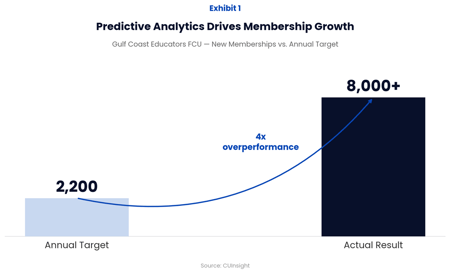 Gulf Coast Educators Federal Credit Union expanded its field of membership statewide across Texas and used predictive analytics to identify high-propensity prospects in a market it had never operated in before. AI-powered modeling matched hundreds of attributes against ideal member profiles and drove personalized multichannel campaigns. The outcome was over 8,000 new memberships, exceeding their annual target by four times. The model identified who to reach. The existing channels did the rest.
American Express uses the same approach for retention. Predictive models identify early indicators of dissatisfaction and route those insights to service teams before the customer has decided to leave. The result is measurable improvement in retention among the customers most at risk.
Both cases follow the same logic. The insight was connected to a channel. Action followed. The technology was not the hard part.
The State of the Industry
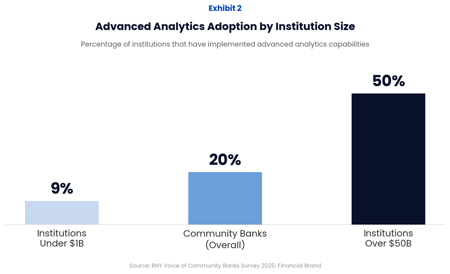 Fewer than one in five community banks have invested meaningfully in data analytics and business intelligence tools, according to BNY's 2025 Voice of Community Banks Survey. Among institutions under one billion dollars in assets, less than nine percent have implemented advanced analytics. Among banks over fifty billion in assets, that number is fifty percent.
The gap is real and it is growing. The institutions pulling ahead are not doing so because they have better data. They have made a cultural decision to trust analysis over instinct when the two conflict. That decision is available to any institution willing to make it. Most are not there yet.
The Harder Question
The rearview mirror is not just a habit. It is a leadership identity. Changing it requires someone in the organization to be willing to say that experience, while valuable, is not sufficient on its own anymore. That the member base is too large, behavior too complex, and competition too fast for any individual's pattern recognition to carry the full weight of strategic decisions.
That conversation is uncomfortable. It implies that the leaders who built the institution may not be equipped to see where it is going. Most organizations are not ready to have it.
The ones that are will look different in five years. Not because they bought better software. Because they decided to aim their judgment forward.
Connect with Finalytics.ai to learn more.