By Alex Jimenez, Managing Director, Strategy, Finalytics.ai
Neobanks aren't out-banking established institutions. They're out-focusing them. The gap is mostly discipline, not capability – and it is closable.
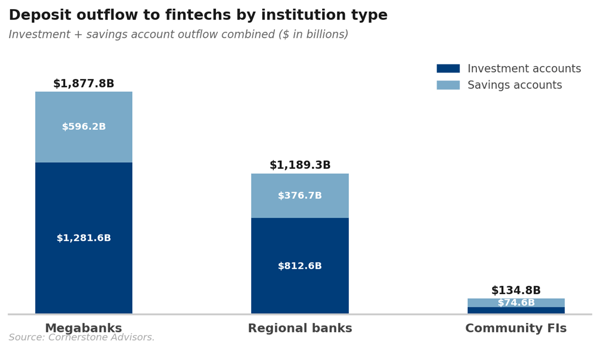
Last year, I met with a banker who lamented how difficult it is to attract new clients and keep the best ones. She referenced a Cornerstone Advisors report finding that in the last five years, banks and credit unions have watched over $3 trillion in deposits leave for fintechs offering savings and investment services.
Several years before, she had told me she didn't expect neobanks to impact her organization, because "our clients trust us and we offer better products."
She was concerned now. Customers still had accounts with the bank, and their salaries were still being deposited there. But many accounts were no longer being used as primary accounts. She could see transfers to Chime, Varo, and other digital banks with no other activity. Product per customer rates were declining.
"How could this be?" she said. "We have products for young people, families, pre-retirees, retirees. Whoever you are, we compete well against any of these new banks."
Neobanks aren't out-banking established financial institutions. They're out-focusing them and out-activating them – and the gap is closing faster than most institutions recognize.
The data advantage belongs to the incumbent. The personalization advantage belongs to the challenger. That is not a permanent condition.
What Neobanks Actually Do Differently
Neobanks are not in the same business as banks and credit unions. They are in a different business altogether. You can see it immediately on their websites. Chime, Revolut, and NuBank do not sell banking products. They sell experiences. The app experience backed by banking services is the product.
They are also disciplined about who their members are in a way most FIs are not. There are more similarities between Navy Federal and Chime than there are between Navy Federal and the community bank down the street. When you hear neobank executives talk strategy, they are talking about a specific person, not a market.
This doesn't mean Chime turns away a Boomer who still writes checks and withdraws cash from the ATM every week. But that person is not their target. Their target is the mobile-first, time-pressed Millennial or Gen Zer. The strategy is to not dilute the brand by trying to serve everyone. They identified a specific profile and optimized the entire experience for that profile. It is not just a marketing decision. It shapes product, onboarding, communication cadence, and feature prioritization. The result is an experience that feels frictionless to the target customer because it was designed exclusively for them.
There is a second, equally important difference. Neobanks are better at activating behavioral data in real time. They don't have better data. They have better use of data. Because of their focus, they have built experiences driven by behavioral triggers – relevant offers and actions delivered at the moment of maximum relevance.
It is not just "next best product." It is next best action. A micro-advice nudge, a congratulatory message, early paycheck access, spending pattern alerts, savings prompts timed to actual behavior. Not calendar-driven campaigns that go out to everyone on the same Tuesday. The sophistication isn't in the algorithm. It is in the decision to build activation infrastructure around data they already had.
The Gap You Can Actually Close
Don't try to out-Chime Chime. That is not a winning strategy. Remember, Blockbuster failed miserably when they tried to be Netflix.
Community FIs have more data per member than most neobanks, due to longer history, more product relationships, and local context. The gap isn't data. It is activation.
Consider what happens when a member overdraws near payday. Chime's SpotMe feature automatically covers debit purchases, ATM withdrawals, and card transactions up to $200. Banks and credit unions typically decline or fee-penalize these signals, worsening anxiety for consumers facing them monthly.
The irony is that the data advantage belongs to the incumbent, but the personalization advantage belongs to the challenger. That is not a permanent condition.
Three Strategies to Win Back the Initiative
Here is what community FIs can actually do, starting now.
Disciplined segment targeting
Not narrowing who you serve. Knowing which segments are highest-value and highest-risk and directing attention there. The community mission doesn't change. The allocation of focus does. The question to start with: which members are most likely to drift in the next 18 months, and what do you actually know about them? A useful starting signal is members aged 25 to 40 whose direct deposit is active but who have opened no additional products in the past 24 months and whose app engagement is declining. That profile exists in your data today.
Georgia United Credit Union ($2.4B, Duluth, GA) applied this kind of targeting when their membership started declining after years of steady growth. Their analysis identified two specific opportunities: dormant members and rural markets within their community charter. Focused targeting – including a no-credit-pull membership application and three-minute mobile onboarding – reversed that trajectory. They finished 2025 above 5% membership growth.
Act on signals you already have
Identify three to five behavioral signals in your transaction data you are not currently acting on: balance migration, direct deposit changes, dormancy creep, declining product per member. This is not a technology project. It is a discipline decision. You don't need new infrastructure to act on a member who hasn't logged in for 90 days or whose direct deposit dropped by 40%.
Georgia United activated this with dormant members, launching outbound calling for retroactive incentives and re-engagement campaigns with messages like "We're lonely, we miss you." Chime can't make that call. They don't have the relationship history to make it credible. Community FIs do. Most just haven't built the habit of using it.
Make the relationship visible at the right moment
Trust and local knowledge are real, but only when members experience them as timely, relevant contact. Not a quarterly statement. Not a branch visit they didn't initiate. Georgia United's new account-opening technology presents loan options at the moment of opening, structured like a shopping cart, with discounts tied to checking relationships. Bundled benefits like telehealth and prescription discounts came directly from member feedback about what they were actually struggling with. That is relationship data converted into a product decision. The member who feels known at a financially significant moment is not going anywhere.
The neobank advantage is real. It is not insurmountable. It is mostly a discipline gap, not a capability gap. Georgia United reversed years of membership decline not by out-technologizing anyone, but by getting disciplined about who they were talking to, acting on signals they already had, and making the relationship tangible at the right moments.
The window is narrowing, not closed. Closing it requires a different kind of intentionality than most institutions have applied so far.
Connect with Finalytics.ai to learn more.